

Beyond the Headlines: Brazil’s Political Future After Lula’s Election Victory
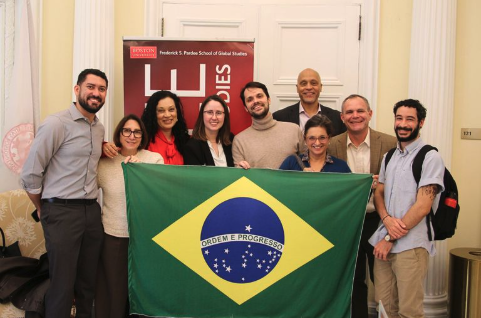
Faculty experts and researchers gathered on October 29, 2026 for a timely Beyond the Headlines discussion titled “Elections in Brazil: What Next for Latin America’s Largest Democracy?”, examining the implications of Brazil’s October general election, and what President Luiz Inácio Lula da Silva’s win against conservative opponent and Trump ally, senator Flávio Bolsonaro, could mean for the country’s future.
Pardee and BU experts gathered to discuss the 2026 Brazilian elections.
Moderated by Ana María Reyes, Director of the Center for Latin American Studies, the panel featured Taylor Boas, Professor of Political Science and Latin American Studies; Renato de Gaspi, Pardee School lecturer; and Marina Zucker-Marques, Senior Academic Researcher, Global Economic Governance Initiative. Together, the panelists analyzed the election’s significance for Brazil’s domestic politics, economic policy, environmental agenda, and international relations.
Taylor Boas. Photography by Sophie Pratt.
Boas began by unpacking the election results, arguing that the runoff outcome was less surprising than many observers believed. “What I think was unusual was the first round,” he said, pointing to increased turnout, effective voter mobilization, and the return of some voters to their traditional political preferences in the second round. Brazil’s regional political divides, he noted, remained largely unchanged from previous elections. Reflecting on the final result, Boas remarked that “the chickens came home to roost in the runoff,” as familiar voting patterns reemerged.
The panel also cautioned against interpreting recent electoral outcomes across Latin America as evidence of a sweeping ideological shift. Instead, speakers suggested that economic frustrations and dissatisfaction with incumbent governments may explain many of the region’s political changes.
Renato de Gaspi. Photography by Sophie Pratt.
The discussion then turned to Brazil’s economy, environmental policies, and powerful agribusiness sector. De Gaspi emphasized that agribusiness represents more than a source of economic activity for many Brazilians. “It is also about your identity,” he said, explaining why support for Bolsonaro remains especially strong in regions dominated by large-scale agricultural production. At the same time, he highlighted ongoing concerns about Brazil’s economic structure and efforts to strengthen domestic industry. “The policy is there; it’s not bad, but it’s definitely not enough,” De Gaspi said of initiatives aimed at diversifying the economy and addressing long-term deindustrialization. Panelists also debated Lula’s environmental record, discussing both reductions in illegal deforestation and tensions surrounding continued support for some forms of energy development.
Economic governance and financial markets were central themes of Zucker-Marques’s thoughts. While markets had reacted strongly to expectations surrounding the election, she urged participants to focus on Brazil’s deeper structural challenges, including high borrowing costs, capital flows, and fiscal constraints. “The whole model needs to change,” Marques argued, calling for a reassessment of the country’s macroeconomic framework.
The panel explored questions surrounding sovereign debt, investment, and development financing, as well as how Brazil can fund industrial and environmental priorities in the years ahead. Speakers also addressed concerns about the influence of social media and technology companies on elections, most notably META’s platforms allegedly favoring Bolsonaro’s right-wing campaign over Lula’s.
Marina Zucker-Marques. Photography by Sophie Pratt.
Looking beyond Brazil’s borders, the panel examined what Lula’s presidency could mean for the country’s role in international affairs. Zucker-Marques predicted stronger engagement with China while stressing that Brazilian foreign policy remains fundamentally pragmatic, observing that Brazil has no problems in doing business with multiple partners and pursues a strategy that balances relationships with the United States, Europe, China, and countries across the Global South.
The discussion concluded with reflections on what Brazilian voters expect from their leaders moving forward. Increasingly, panelists argued, citizens are seeking more than protection from poverty. As Zucker-Marques noted, “They want better cars. They want better houses,” noting on the expansion of what Brazilian voters will want from their policies, infrastructures, and more. Understanding those evolving expectations, the panel suggested, will be critical to understanding both Lula’s presidency and the future direction of Latin America’s largest democracy.