
Shaping Europe’s Future: Garčević Brings Western Balkans Perspective to Bled Strategic Forum
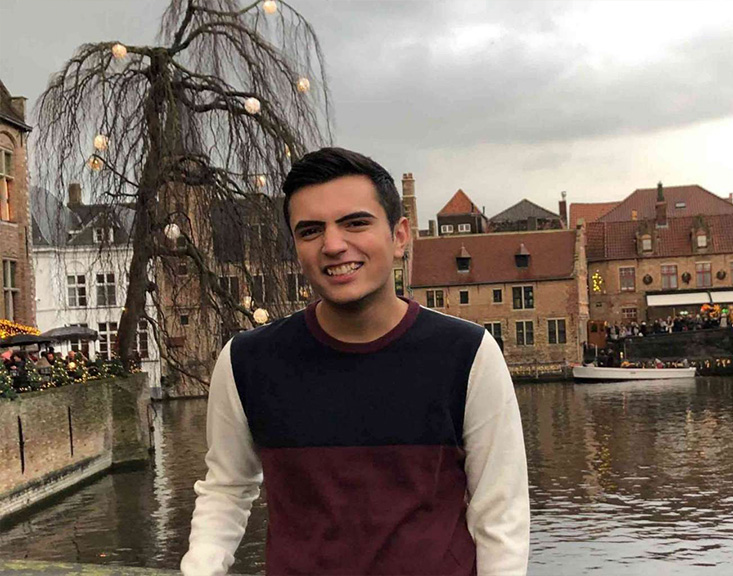
Ambassador Vesko Garčević, Professor of the Practice of International Relations at the Pardee School, participated in the Bled Strategic Forum 2026, held in Slovenia on August 31 and September 1. Under the theme The Power to Shape the Future, the Forum brought together heads of state and government from EU member states, EU Commissioners, representatives of the U.S. Department of State, diplomats, experts, and academics to discuss Europe’s geopolitical challenges and its role in shaping the future.
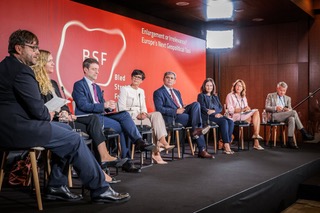
On the second day of the Forum, Ambassador Garčević served as a panelist on Enlargement or Irrelevance? Europe’s Next Geopolitical Tool. The panel featured Marta Kos, European Commissioner for Enlargement; Ferit Hoxha, Minister for Europe and Foreign Affairs of Albania; Ervin Ibrahimović, Minister of Foreign Affairs of Montenegro; Tamara Weingerl Požar, State Secretary for European and Political Affairs at the Slovenian Ministry of Foreign Affairs; Natalie Kauther, Director for the Western Balkans at the German Federal Foreign Office; and Vessela Tcherneva, Deputy Director of the European Council on Foreign Relations, Bulgaria. Adnan Ćerimagić, Senior Analyst for the Western Balkans at the European Stability Initiative, moderated the discussion.
Amb. Vesko Garčević
In his intervention, Garčević questioned why highly developed European non-European Union (EU) countries avoid membership in the EU, while states from the Western Balkans or Ukraine continue to view EU membership as a strategic priority.
He argued that these two groups of countries have often sought different things from European integration: Iceland or Norway have almost everything that EU membership offers. They’ve built a mutually beneficial relationship where membership is not a necessity, and therefore they don’t need to formalize the process. Garčević noted,
“For the other group, EU membership is much bigger; it is not just about being part of the single market; it is a process of democratic transformation,”
He emphasized that this transformation is closely connected to the original purpose of European integration itself. He said,
“The original idea of the European Community was born to change the geopolitical environment in Europe, ensure peace and stability, and allow economic growth. Prosperity, political transformation, and democratic consolidation of the continent.”
Garčević described enlargement as a political necessity and called for a more flexible and dynamic approach to integrating countries aspiring to join the EU. He underscored that enlargement should be understood not simply as an institutional or economic process, but as a central geopolitical instrument through which the European Union can advance stability, democratic consolidation, and prosperity across the continent.
Vesko Garčević is a professor of the practice of international studies at the Frederick S. Pardee School of Global Studies and the director of the Center for the Study of Europe. An expert on multilateral issues, Garčević is the co-author of Montenegro and Serbia: A Velvet Divorce? (Bloomsbury Academic, 2025) which explores the divergent past between Serbia and Montenegro between 1988 and 2023. To read more about his work and accomplishments, visit his faculty profile.