
Pardee School Marks 25 Years Since 9/11 with Global Reflection on the War on Terror
Written by Lillie Brown (BA’27)
Professor of the Practice of International Relations, Joe Wippl during Pardee’s event commemorating 25 years since 9/11. Photography by Zakiya Majeed-Landau (BA’27)
On September 11, 2026, the Pardee School for Global Studies hosted a day of reflection and discussion with Pardee faculty and experts on the 25th anniversary of the 9/11 terrorist attacks on the World Trade Center. This event titled ‘9/11 and the Global Perspective: Marking 25 Years Since the Start of the “War on Terror”,’ wove together stories from the day, along with commentary and discussion on how the United States’ response to the attacks still has ramifications today. The speakers consisted of Joseph Wippl, Professor of the Practice of International Relations and former CIA officer; Mary Margaret Graham, Chief of the CIA New York Office on 9/11/2001; Thomas Berger, Professor of International Relations; Shamiran Mako, Associate Professor of International Relations; Jessica Stanton, Visiting Professor; Noora Lori, Associate Professor of International Relations; Mark Storella, Professor of the Practice of Diplomacy and former U.S. Ambassador to Zambia; and Michael Ratney, former Ambassador of the U.S. to Saudi Arabia.
On September 11th, 2001, al-Qaeda conducted a devastating attack on the U.S., hijacking four planes and flying them into the World Trade Center, the Pentagon, and into the ground in Pennsylvania. This attack claimed the lives of nearly 3,000 people and left survivors with lasting health problems from exposure to smoke and the shock of the event. The attacks led the U.S. to alter its way of living and its foreign policy agenda and respond militarily, invading Afghanistan in October of 2001 and Iraq in 2003, as well as carrying out an operation to kill al-Qaeda leader Osama Bin Laden in 2011.
Joe Wippl was joined by Mary Margaret Graham to discuss their experiences at the CIA during 9/11. Photography by Zakiya Majeed-Landau (BA’27)
This forum covered the events leading up to, during, and following 9/11, creating a discussion that reflected on the world’s response to these attacks and how it fundamentally altered U.S. foreign policy. In his opening remarks, Wippl acknowledged the gravity of the day and shared brief comments on his own experience. The first portion of the discussion focused on the immediate political battles domestically in the U.S. regarding the best path to responding. There was bureaucratic friction over authorities and priorities between the intelligence and defense communities that ultimately led to politicized and faulty intelligence on weapons of mass destruction in Iraq.
Graham reflected on her experience on 9/11 when the planes hit. She recalled a beautiful day suddenly shattered by the smoking towers and the horrific scenes. She shared various anecdotes that captured the sacrifice of the first responders and the selflessness of her CIA colleagues. On her ride home the night of 9/11, the streets were empty, except for the stream of first responders speeding towards the city, towards Ground Zero.
She shared that she had sent most of her team home that morning, but later discovered they had stopped at a daycare to help take the children to their homes. To that she remarked, “If that does not show the type of people who work at the CIA, I don’t know what does.” The discussions led to her experiences working in NYC after the attacks and having to adapt to a completely different threat landscape, where terrorism became a forefront issue in her work.
(Left to right) Thomas Berger and Joe Wippl during Pardee’s event commemorating 25 years since 9/11. Photography by Zakiya Majeed-Landau (BA’27)
Berger shared a strategic view after 9/11 and how the attacks changed how the U.S. viewed terrorism and international security. First, he discussed the role of radicalized political Islam, and he connected several historical events to its rise. One was the failure of Arab nationalism militarily, politically, and economically, which was contrasted with the successes of the Mujahideen in Afghanistan against the Soviet Union. Additionally, the Iranian Revolution helped supercharge radical political Islam and foster the environment for groups like al-Qaeda to emerge.
Berger also discussed the response after 9/11, examining the U.S.’s military actions in Afghanistan as an initially successful campaign, which then spiraled into a long and difficult war of nation-building and counterinsurgency that resulted in enormous human and political costs. Berger ended with lessons from the aftermath of the attacks, emphasizing the importance of expecting the unexpected, listening to experts, and avoiding straight-line extrapolation.
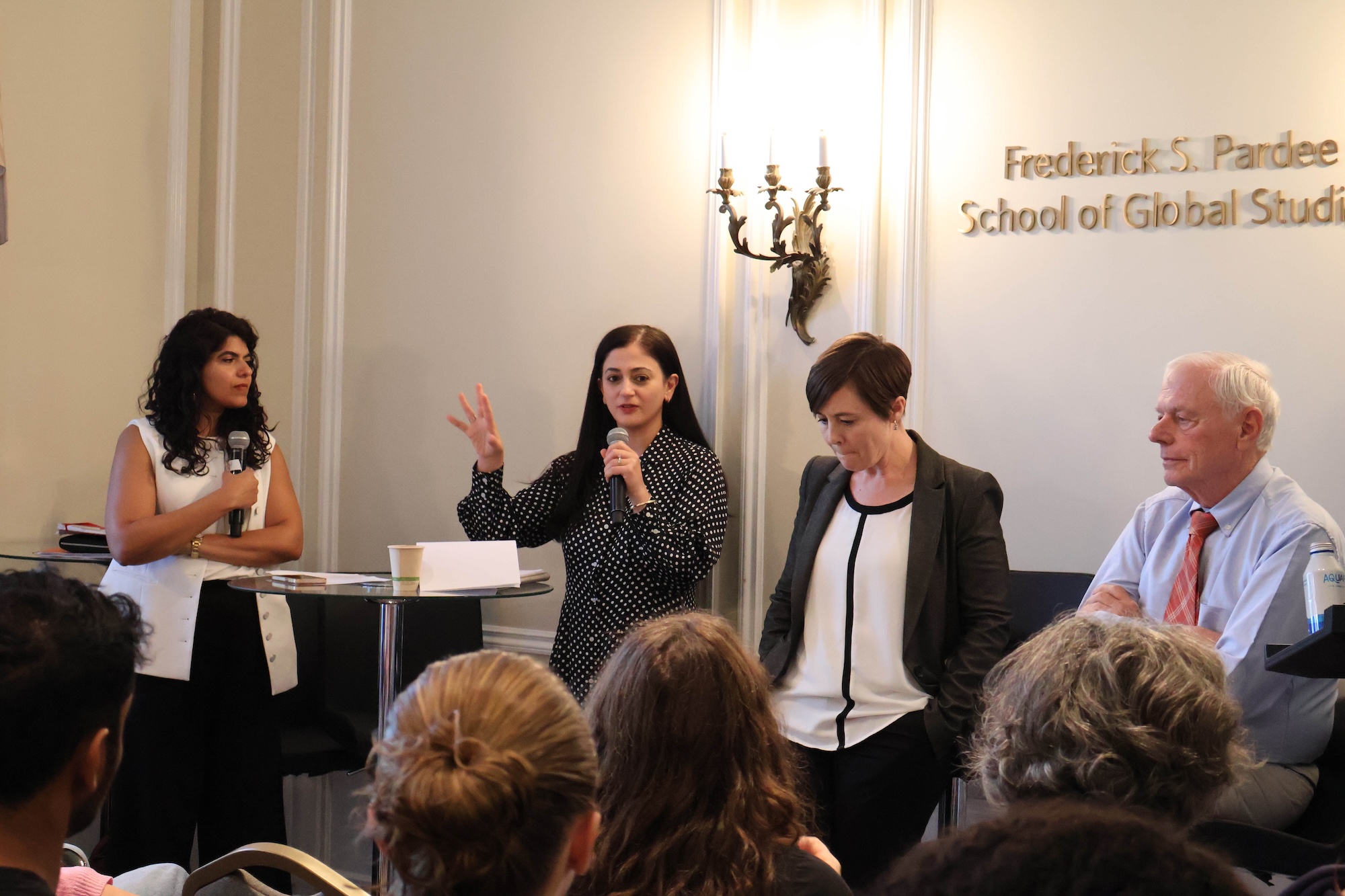
(Left to right) Professors Lori, Mako, Stanton, and Wippl in a panel discussion on the U.S.’s response to 9/11, 25 years later. Photography by Zakiya Majeed-Landau (BA’27)
Next, a panel of Wippl, Stanton, Mako, and Lori discussed similar scenes from their own 9/11 experiences of shock and disbelief. They discussed the challenges that governments faced after 9/11 in responding to an attack by a non-state actor. Terrorism was a new type of enemy, one without a territory but with an ideology that was spread over many territories. This led to the criminalization of terrorism, where states passed laws that made arresting and identifying terrorists easier. Nonetheless, countries abused this new phenomenon and took to labeling political opponents and minority groups as terrorists to justify aggressive actions against them. The U.S. also became driven by the desire for revenge, contributing to the expansion of the Global War on Terror (GWOT) and the overall painful legacy of the wars that followed.
Ambassador Ratney and Storella wrapped up the discussion with thoughts on how 9/11 changed diplomacy itself. After the attacks, the U.S. changed in many ways: stricter airport security measures, the creation of the Department of Homeland Security (DHS), the creation of the Office of the Director of National Intelligence, and more. To Ambassador Ratney, “9/11 changed the way the U.S. interacted with other countries. And as a Foreign Service Officer (FSO), it changed the way things in the State Department operated.”
(Left to right) Mark Storella, Ambassador Michael Ratney, and Joe Wippl discuss the effects of 9/11, 25 years later. Photography by Zakiya Majeed-Landau (BA’27)
Additionally, both agreed that the U.S. made a strategic error after 9/11 when they began evaluating other countries based on how much support to the U.S. they were providing. This approach demonstrated the U.S. viewed the world as either “with us or against us,” and in turn weakened trust and relationships with countries whose interests were perceived to misalign with the U.S.’s.
The shift demonstrated that the U.S. was fueled by fear and urgency after 9/11, which reflected in its diplomacy, as the GWOT displayed an erosion of norms, extraordinary renditions, torture, and little care for collateral damage. Ratney and Storella concluded with the observation that the world we live in today has been shaped by the ways diplomacy has been used as a tool of foreign policy and by the decisions made by those in power.
Throughout the forum, the audience engaged in thoughtful discussion on the attacks and on the U.S.’s response, highlighting the strategic mistakes they perceived to exist in the U.S. military action after 9/11. Much attention was given to how this event had lasting impacts on modern foreign policy, and how lessons could be taken from examining what went right and wrong in the GWOT.