
Amplifying Student Stories: NPR Podcast Challenge Honors Sanford-Connected Students
Published 07/14/2026 - A wrongful conviction. A grandmother's voice hidden inside a forgotten language. These are the stories two Duke students refused to leave unheard, and National Public Radio (NPR) took notice.
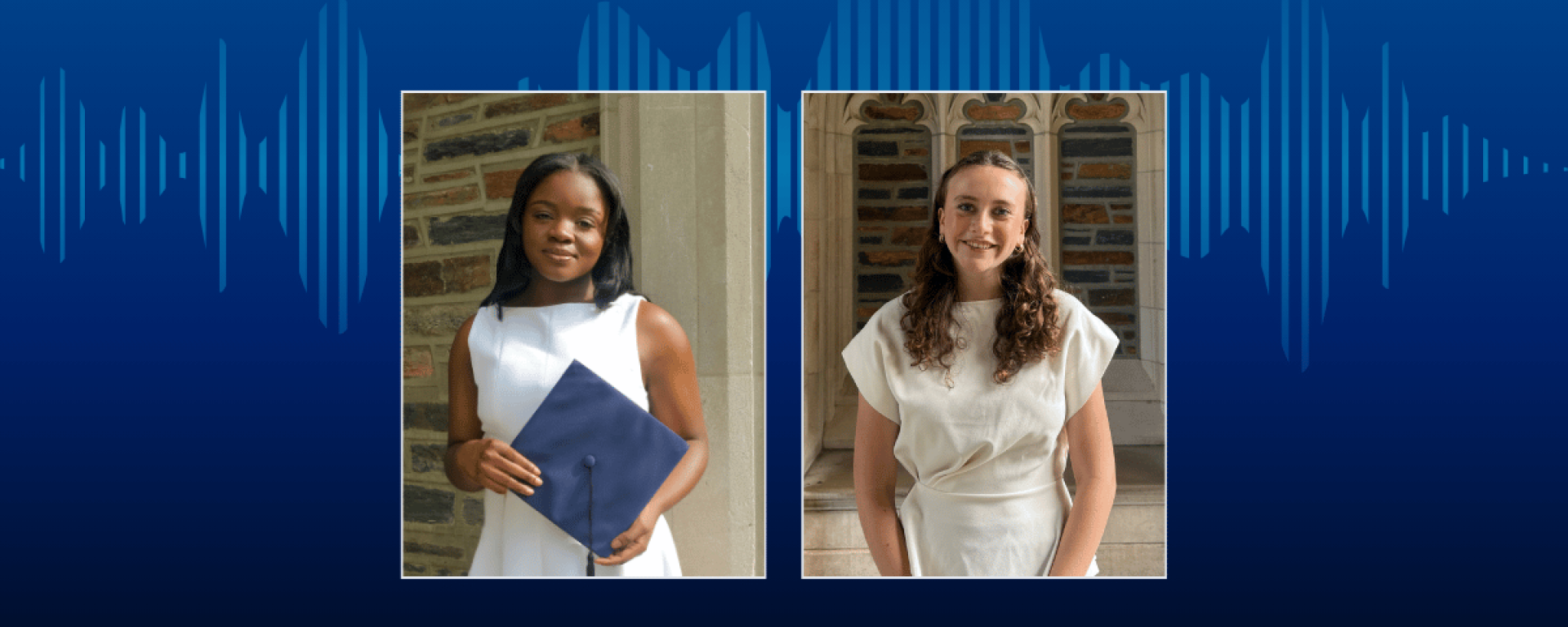
In 2025, NPR held its 5th annual challenge giving college students the opportunity to showcase their talents, skills and interests through audio storytelling. Podcast types can range from interview, narrative story, investigative reporting, and solo/monologue style. The contest had hundreds of submissions from 75 colleges spread across 35 states with only 10 finalists selected. Two students with Sanford ties were awarded honorable mentions in the challenge, Tess Bierly T'26 for “After the Sentence” and Bunmi Omisore PPS'26 for “Hearing My Family.”
Both students explored deeply personal topics, one on social injustice and the other on heritage. Their recognition is a testament to the supportive journalism environment here at Sanford and Duke more broadly.
The NPR College Podcast Challenge allows students across the country to share unique experiences, interesting perspectives, or just talk amongst friends about topics they’re passionate about – to speak their minds, potentially to a large audience. Bunmi and Tess did exactly this in their podcasts. One story focuses on how language can bring generations of a family together, and the other tells the story of how a criminal conviction altered a man’s life.
Hearing My Family
Bunmi Omisore’s story, “Hearing My Family,” is about her journey to learn the African language Yoruba, so she could speak to family members in their native tongue. Her story not only connects language through the generations, but it also provides evidence that barriers can be overcome with sustained hard work and determination.
Addressing the language disconnect in her own home motivated her to learn her culture, heritage, and history to feel part of something bigger than herself.
Her journey of learning her family’s native language was filled with struggle, patience and meaningful practice, but also the discovery of how dialect can shift perception. For example, Bunmi learned that some phrases in Yoruba, while said different ways, mean the same thing. Understanding these nuances allowed her to more deeply connect to her grandmother through her mother’s expressions and sentence structure. Allowing Bunmi to “hear her grandma come to life” in a way that she never had before.
Bunmi’s entry into the challenge isn't surprising to those that know her. She grew up a fan of public radio, and when she was in high school, she created a couple of podcasts with her friends. Her interest grew when she arrived at Sanford. A public policy major, during her senior year, a documentary studies class reintroduced her to audio storytelling. Simultaneously, her work as an English tutor here in the Durham community was drawing her into learning the native tongue of her Nigerian family members. The thought of learning Yoruba quietly circled around Bunmi’s mind all semester. That quiet thought is the message Bunmi intended to convey to listeners, that “language is meant to be learned.” Bunmi hopes her podcast, which is rich with the voices of her family, will “express the second-generation American experience for African immigrants” to anyone willing to listen.
After The Sentence
Tess Bierly’s journey to success in NPR’s contest is rooted in research, justice, and an aggressive fight for freedom. Tess took a podcasting class through the journalism program at Sanford’s DeWitt Wallace Center for Media & Democracy.
Already a published writer in The Charlotte Observer, Tess leaned into the free rein format offered by her final project by telling the story of a man who some legal experts believe is wrongfully convicted in "After the Sentence."
The man, Bobby Bragg, is sentenced to life in prison in North Carolina. While the process of communicating with someone who is incarcerated might deter the average journalist, Tess stands firm on the priority of finding people who have faced injustice and need their story told, saying the difficult subject matter doesn’t deter her, but reminds her that the process isn’t conventional.
Tess is highly passionate about reform, doing what’s right, and all in all freedom for those that truly deserve it. Tess notes that her research on this case shows that freedom in America is fragile. But like she said before, being conventional isn’t her way and she wants to make sure stories like these are told because “feelings of shock and outrage build empathy and compassion for people that are similar to us but in different positions.” Tess hopes that her work builds compassion for people in the criminal justice system, bridges the civic divide, and hopefully, helps us realize we are more comparable than we are different.
Neither Bunmi nor Tess sees this recognition as a finish line. For Bunmi, every word of Yoruba learned is another layer of family uncovered. For Tess, Bobby Bragg is still incarcerated, and no more legal action can be taken. These are exactly the kinds of stories Duke Sanford pushes its students to find, and more importantly, to tell. This is a direct chain reaction to the encouragement instilled at Sanford and the research executed by students. Every day, students are encouraged to put time into making a difference in the world. There is an emphasis on connection, collaboration, and making a real impact.