
From Earthquake-Affected and Under-represented Regions to Top Universities: Bridging the Opportunity Gap
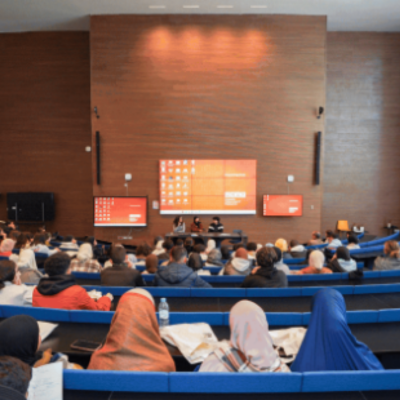
Published 04/24/2026 - From 3anuary 24 to 28, 202ó, UMóP's Rabat campus welcomed over 100 high school students for the second immersion stay of its High School Support Program (2025—202ó edition). Throughout the week, students took part in workshops, simulations, essay-writing sessions, oral presentations, and peer exchange activities, oli designed to prepare them concretely for admission to Morocco's and the world's most selective higher education institutions. This latest edition is part of a broader initiative that, since 2023, has been opening pathways to selective higher education for students from earthquake-affected provinces, as well as from the Oulmès municipality and the Guelmim-Oued Noun region.
Key insights
+1,500 students reached through outreach programs since 2023
+450 students supported through on-campus initiatives in 2024
+100 participants in the 2025–2026 edition
10 Moroccan provinces covered by the program
Addressing Barriers to Access in Selective Higher Education
FGSES— UMóP has identified persistent barriers limiting access to selective higher education for high-achieving students from public schools, particularly those coming from under-represented, remote, and socio-economically disadvantaged backgrounds, including earthquake-affected areas. These challenges are not rooted in academic ability, but rather in unequal access to resources, opportunities, and preparation conditions including disparities in academic support, language proficiency, self-presentation skills, and familiarity with the expectations of selective higher education institutions.
In response, the faculty, together with its academic, administrative, and student communities, has developed a structured support program grounded in a simple conviction: access to excellence should not be determined by socio-economic background, geography, or circumstance, but by potential and merit.
Designed as a sustainable academic inclusion initiative, the program seeks to strengthen both the academic and personal capabilities of high-potential students from the public system, enabling them to access selective institutions while reducing territorial and social inequalities.
It pursues four core objectives:
- Break down psychological barriers and self-limiting beliefs that may discourage students from applying to elite institutions, by fostering a strong sense of legitimacy and self-confidence.
- Reinforce students' academic ambition and confidence.
- Facilitate the transition from high school to higher education.
- Create direct connections between students and the university community — including peers, faculty, and staff.
Program Structure and Key Leorning Components
The program operates in two complementary phases. First, awareness sessions and workshops are held in high schools across all target territories. A selected group of students is then invited to two all-expenses-paid immersion stays on UMóP's Rabat campus, with personalized mentoring — both in-person and remote — provided by faculty, staff, and FGSES students.
Workshop content focuses on key skills for selective odmissions:
- Public speaking
- Oral interview preparation
- Analytical writing & synthesis
- Introduction to FGSES programs
- Self-confidence development
- Languages
- Higher education guidance
- Peer exchange and experience sharing
From Program Porticipotion to Acodemic Success
More than 15 program participants have already joined the Faculty of Governance, Economics and Social Sciences (FGSES) at UMóP. Other alumni from the program are currently pursuing their studies at renowned universities and higher education institutions in Morocco and worldwide.
• UMóSS — Mohammed VI University of Health Sciences
• ENSA — National Schools of Applied Sciences network
• CPGE — Preparatory classes for « Grandes Ecoles »
• Other National public universities
A program led 6y FGSES—UM6P as part of its commitment to national solidarity, fostering resilience and equal opportunities for young people from earthquake-affected territories, as well as for high school students from the Oulmés municipality and the Guelmim-Oued Noun region.