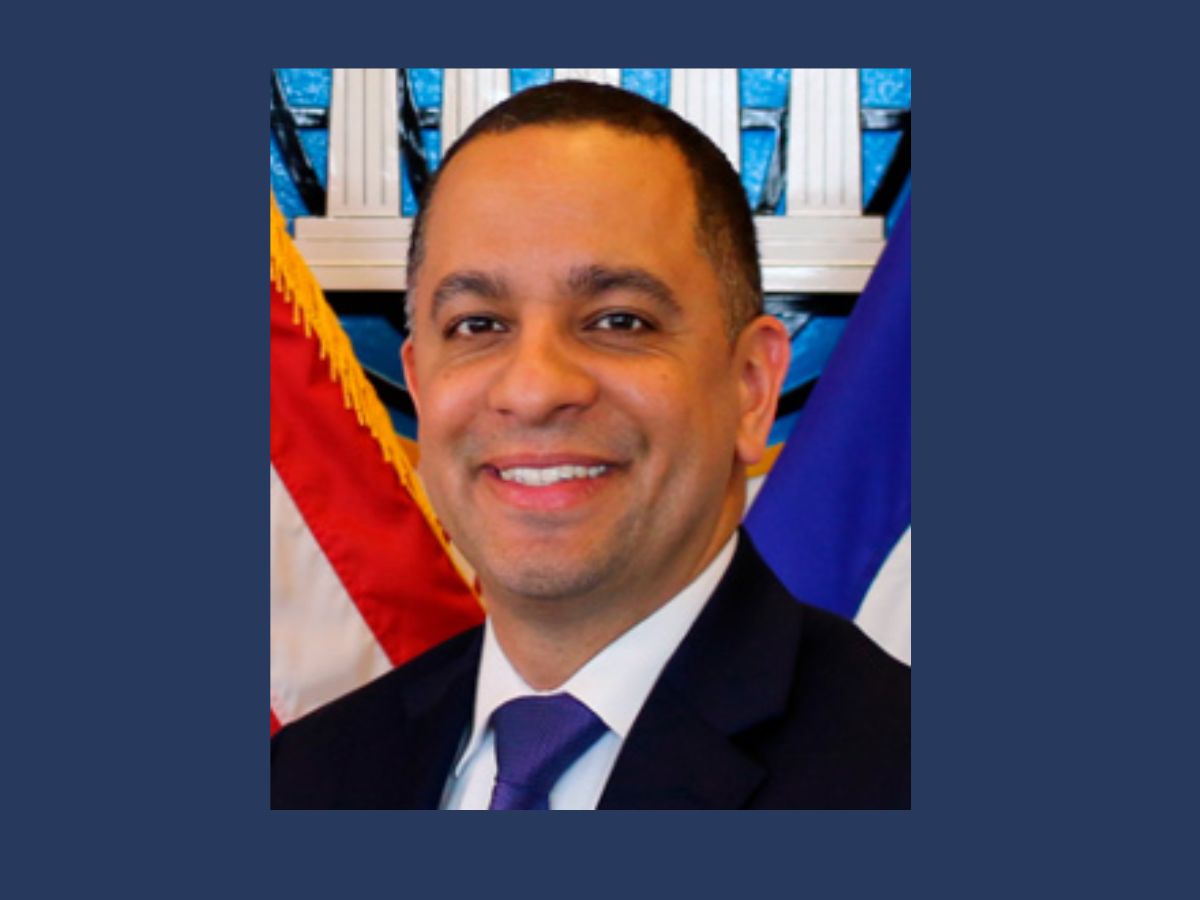

Seeing the Bigger Picture: Sergio Fontanez on the Value of an International Affairs Education
When Sergio Fontanez joined the Export-Import Bank of the United States (EXIM) as senior advisor for national security, he was not a finance expert.
“I didn’t know the difference between a loan and a loan guarantee,” he recalled.
Instead, he brought a background in national security, international affairs, and law, and the ability to learn quickly and connect different perspectives. For Fontanez, who earned a Master’s in International Affairs from the George Washington University’s Elliott School of International Affairs in 2018, those abilities are central to the value of an international affairs education.
He describes that combination as becoming an “apex generalist”: someone who can enter an unfamiliar field, understand its broader implications, and bring together people with different expertise.
From the State Department to Economic Security
Fontanez has applied that approach across military service, government, law, and economic security. A U.S. Air Force veteran, he later worked at the U.S. Department of State, including an assignment at the U.S. Embassy in Tokyo, practiced international trade law, and supported international partnerships and foreign military sales.
An important turning point came during his LL.M. studies in national security law at Georgetown University. He began exploring how economic tools could advance national security goals by helping allies reduce strategic dependencies. That research later informed his work at EXIM, where he helped develop a supply chain resilience initiative supporting critical mineral mining and processing in allied countries.
The initiative brought together several strands of his education and experience. His legal training helped him examine what the bank was authorized to do. His international affairs training helped him understand the policy objectives and geopolitical implications. Moving the initiative forward also required working with stakeholders whose priorities differed.
“If we don’t take the time to figure out what their interests are and why and their perspectives, we won’t know how to effectively engage,” he said.
Finding a Place in a Technical Field
Fontanez encourages students to recognize their own ability to connect perspectives. When he recently moderated an Elliott School panel on critical minerals, supply chain resilience, and China, students wanted to know how to find their place in a field that can appear highly technical.
His message was that international affairs graduates bring something valuable: an understanding of the wider context. They can ask how a decision affects other countries, industries, or policy goals, and help ensure that those considerations reach the people making decisions.
He encourages students to think broadly about the work they want to do, starting with the daily experience. Do they want to solve complex problems? Engage with people from different countries? What skills do they want to learn, and what kinds of meetings do they want to have?
Those questions can reveal career paths students might otherwise overlook, including private sector roles that build skills for an eventual move into government.
The Value of Relationships
Looking back on his own experience, Fontanez wishes he had understood earlier the importance of relationships. As a first-generation college student, he did not always know the value of internships or the opportunities that could emerge from reaching out to someone for a conversation.
“There’s nothing more powerful than being able to say, ‘I’m a student,’” he said. “Most people, in a cold email, will get back to you and give you the 20 minutes that you’re asking for.”
He also urges students to make time to learn from people beyond the classroom, whether through professional outreach, travel, or conversations with peers. He describes this as building sustainable relationships that deepen their understanding of the world.
Across his career, Fontanez has found that broad knowledge and strong relationships help him navigate unfamiliar challenges. His advice to students is to cultivate both: learn to see how issues connect, and make time for the people who can expand your perspective. Those habits can open doors into fields—and roles—you may not yet have considered.
Interview conducted by Jade Williams Jones, APSIA Engagement Coordinator