
Diplomatic leaders engage U-M community at seventh ambassadors forum
The Ford School’s Weiser Diplomacy Center (WDC), in partnership with the Weiser Center for Europe and Eurasia (WCEE) and the American Academy of Diplomacy (AAD), recently hosted its seventh annual Ambassadors Forum. The three day event brought distinguished diplomats and policy experts to Ann Arbor for discussions on America’s role in NATO, the EU, and the future of diplomacy. U-M students, faculty, and Ann Arbor high schoolers had the opportunity to engage directly with seasoned ambassadors during a particularly dynamic period in global affairs.
Given the crucial and constantly shifting political, economic, and security related landscapes of the European and transatlantic relationships, we…think it's absolutely essential for [our university] to host conversations with experts on matters like this,” said Ambassador Susan Page, director of the WDC.
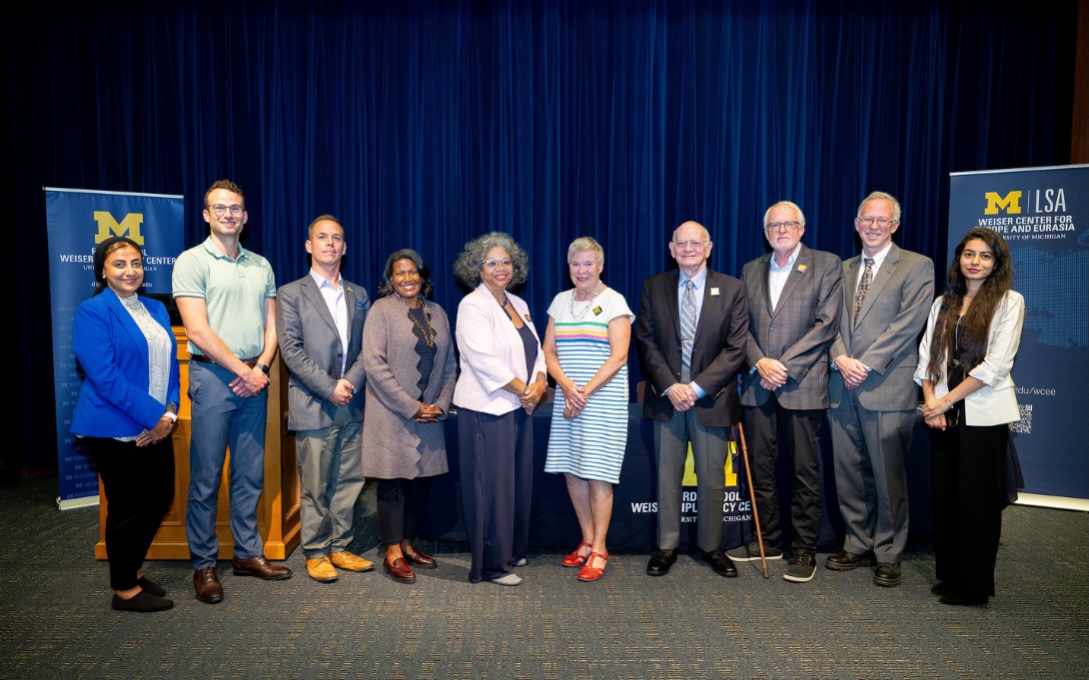
Ten people standing next to one another, smiling and posing for a group photo at the front of an auditorium. Ambassador Neumann, Ambassador Gottemoeller, and Ambassador Beyrle with University of Michigan faculty, students, and staff.
Browse more photos from the event on Flickr: "Europe and America—Where Are We and Where Are We Going?"
Career exploration
Students and faculty had a chance to interact with three esteemed diplomats:
Ambassador Ron Neumann, president of the American Academy of Diplomacy (AAD) and former U.S. ambassador to Afghanistan;
Ambassador Rose Gottemoeller, former NATO Deputy Secretary General and U.S. Undersecretary for Arms Control and International Security; and
Ambassador John Beyrle, chairman of the U.S. Russia Foundation and former U.S. ambassador to Russia.
Throughout their visit, ambassadors met with students to share stories from their careers and advice for those interested in pursuing international service. and bring awareness to diplomacy careers. Many students found the sessions eye-opening.
“I thought the former ambassadors offered a fantastic perspective on both current and past events,” said Emerson Delfin (BA ’27). “I especially appreciated their insight into the differences between how Americans view the world and how other countries approach and interpret similar issues—it was eye-opening.”
Ford School junior Amr Brown (BA ‘27), who is pursuing a career in diplomacy and foreign policymaking, appreciated the opportunity to talk with ambassadors one-on-one and in-depth conversation about relevant global issues. “Yesterday’s forum provided students, faculty, and members of the community with what the Ford School is all about—policy engagement and analysis,” he said.
As part of their yearly tradition, the ambassadors spent a portion of their last day in Ann Arbor off campus answering questions from juniors and seniors at Huron High School and Community High School. "Interacting with students gives us a chance to talk about the reality of diplomacy,” said Amb. Neumann. “It's satisfying to catch [high schoolers] at an earlier point in their career thinking and give them a taste of what diplomacy is.”
Fostering policy dialogue
In addition to sharing information about diplomacy careers, the Ambassadors discussed U.S. foreign policy with the U-M community in a public event and private dinner with invited faculty.
Nayab Ali, the WDC’s international diplomacy programs administrator, noted how cross-disciplinary faculty participation—supported by all co-hosting organizations—fosters robust policy debate and creates new avenues for collaboration. “These conversations not only strengthen the Ford School’s connections and visibility, but also create new avenues of collaboration for our guests,” Ali said.
In a public panel moderated by Ambassador Neumann, the diplomats explored the complex dynamics shaping U.S.-European relations. Their conversation touched on several timely issues.
Ambassador Gottemoeller shared insights on the Trump administration’s more passive approach to NATO, Russia, and the war in Ukraine. Gottemoeller emphasized the historical context of U.S-European relations, including the Obama administration’s pivot to the Indo-Pacific theater and the first Trump administration’s demand for NATO members to fulfill their defense spending requirements.
It [was] Vladimir Putin's second invasion of Ukraine in 2022 that really upped the pressure on the [NATO] allies and led them to embrace, finally, the necessity of modernizing their armed forces. “I like to say the momentum first came from Donald Trump in 2017…but then it was Vladimir Putin who really pushed the momentum with that invasion.”
-Ambassador Gottemoeller
Gottemoeller also expressed doubt that the U.S. would fully withdraw from NATO and other European alliances, citing continued support from department heads and officials at international fora. However, she noted that NATO and the EU are preparing for potential Russian incursion without American support with military exercises, improved infrastructure, and information-sharing across alliances and agencies—mechanisms that allowed NATO to respond effectively and efficiently to Russia’s recent incursion on Polish and Romanian airspace.
Ambassador Beyrle stressed the importance of Russia as a resource-rich asset with strategic geographic opportunities and a massive nuclear arsenal. He discussed the sense of collective loss that Russians have experienced since the fall of the Soviet Union, and how the Kremlin has exploited that grief as a means of spreading anti-West ideology.
“This is the narrative that is being fed to the Russian people on a daily basis,” he said. “It's largely accepted because [for] many people who either grew up during the Cold War or whose parents grew up during the Cold War…this was their daily bread. The West is out to get us.”
To conclude his remarks, he urged the public and policymakers to do two things: don’t give in to Putin, but don’t give up on Russia. Beyrle highlighted ideological differences between the Russian public, many of whom have pro-Western sentiments, and the Kremlin, who furthers division using propaganda. He encouraged attendees not to rule out Russia’s role as a potential ally in the future.
Since 2019, the Ford School has partnered with the American Academy of Diplomacy to host annual panel discussions about foreign policy events. Past forums have put a spotlight on China’s strategic objectives, implications of the Ukraine War, and other timely topics.